Affiliate disclosure: Some links in this article may be affiliate links. We may earn a commission if you purchase via these links — at no extra cost to you. This does not affect our editorial coverage. Full disclosure.
HubSpot Launches Free AI Visibility Dashboard as Its Customers' Organic Traffic Falls 27%
TL;DR
HubSpot released AEO Sensor, a free public dashboard tracking how often ChatGPT, Gemini, and Perplexity cite brands across industries — launching the same week the company disclosed a 27% organic traffic decline for its customer base. No login required. Any operator can benchmark their industry's AI visibility today.
27%
decline in organic traffic for HubSpot customers — consistent with broader industry reports
3
answer engines tracked: ChatGPT, Gemini, and Perplexity — with separate citation and traffic data per engine
$0
AEO Sensor is free with no login required — any operator can benchmark their industry today
12-mo low
ChatGPT-referred click traffic — users are getting answers inside the interface rather than clicking out
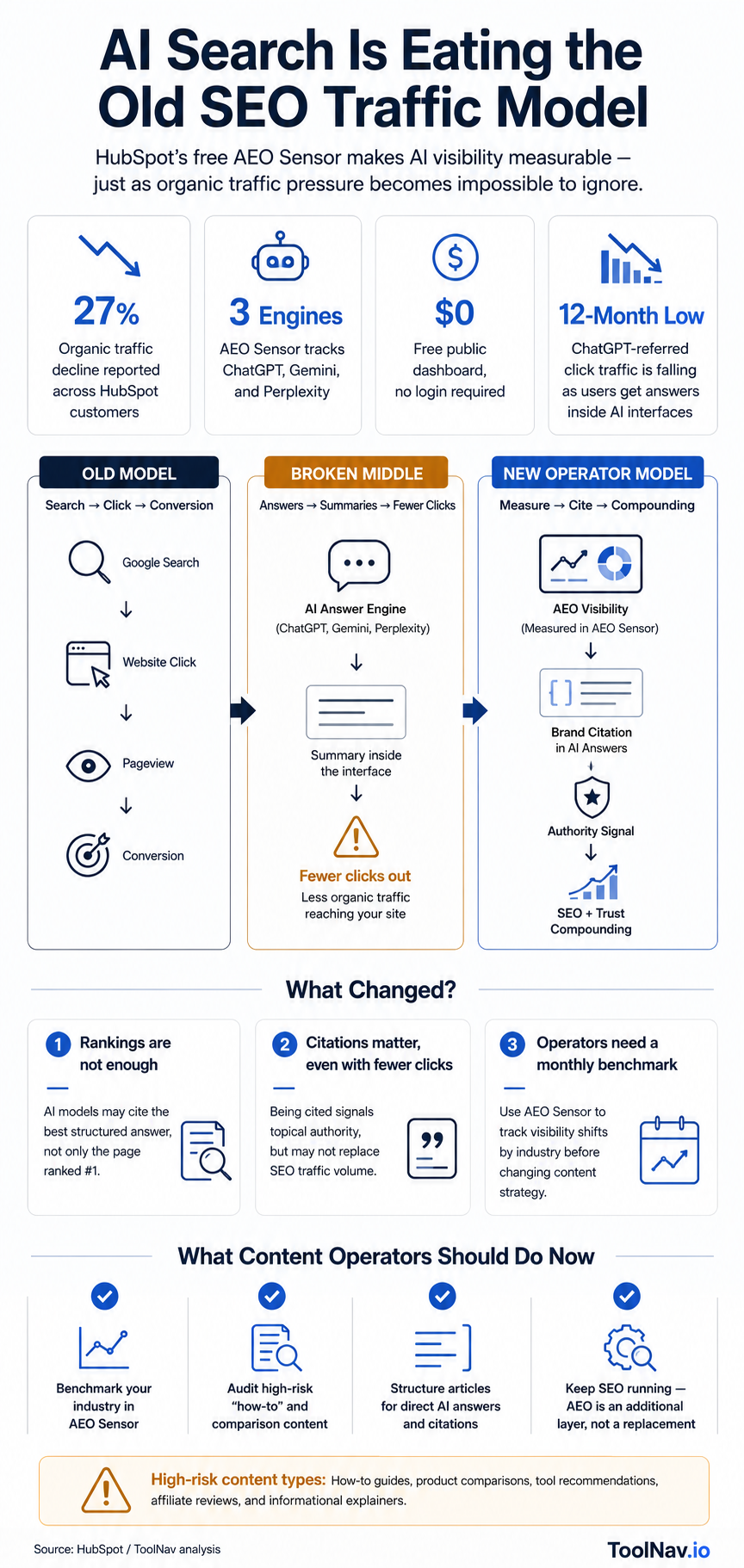
HubSpot launched AEO Sensor on May 14, a free public dashboard that tracks how brands appear inside ChatGPT, Gemini, and Perplexity answer engines — and it landed alongside a disclosure that HubSpot customers' organic search traffic has fallen 27%. The two data points together make the same argument: the traffic model that powered a decade of content marketing is fracturing, and AEO (Answer Engine Optimization) is the next discipline every content operator needs to understand.
What AEO Sensor shows. The dashboard — publicly accessible at hubspot.com/aeo-sensor without signup or subscription — displays three data tracks: daily answer engine volatility (how much AI search behaviour is shifting day-to-day), weekly AI-referred traffic trends by industry, and weekly citation and visibility data broken down by ChatGPT, Gemini, and Perplexity separately. It is an industry-level instrument, not a per-brand tool — it shows whether visibility shifts are market-wide or specific to individual operators. Per-brand analysis requires the separate HubSpot AEO subscription product.
The 27% traffic decline context. HubSpot's disclosure that its customers are seeing a 27% organic traffic drop is not a HubSpot-specific anomaly — it is consistent with what marketers across the industry have been reporting as AI answer engines absorb queries that previously sent users to websites. The pattern is clearest in informational searches: "how to" queries, product comparisons, and tool recommendations — exactly the content that review sites and guides publish. AI search is now answering a meaningful share of queries that used to generate website clicks.
The counter-data point. The launch coincides with data showing ChatGPT-referred traffic hitting a 12-month low — not because ChatGPT is losing users, but because its users are getting answers inside the interface rather than clicking through to source pages. AI models do cite sources, but click-through rates from AI-generated citations are far lower than from traditional search results. Being cited is still valuable — it signals topical authority — but it does not replace the traffic volume traditional SEO generated.
AEO vs SEO. SEO optimizes for ranking in traditional search results. AEO optimizes for being cited as a source inside AI-generated answers. The two are related but not identical: AI models cite content that is authoritative, comprehensive, and directly answers the question — not necessarily content that ranks #1 for a target keyword. Getting cited by Perplexity in a tool comparison answer requires being the best answer to that comparison, not just having the most backlinks pointing at the page.
Why It Matters
This is the first free, operator-accessible data tool for the single most important shift in content distribution since mobile. HubSpot's 27% traffic decline figure gives the abstract AEO narrative a concrete number — and AEO Sensor gives operators a way to benchmark where their industry stands before deciding how much to invest in optimising for AI citations vs traditional search. For anyone running content-driven side hustles, review sites, newsletters, or guides — this is a direct signal about the traffic model you're relying on. The window to adapt is open now; it will narrow as AI search behaviour stabilises.
Who's Affected
- — Content creators and review sites — operators running review and guide content are in the exact category where AI search absorbs the most informational queries. Benchmark your category on AEO Sensor and treat the 27% figure as a planning assumption for 2026–2027 traffic projections.
- — Newsletter operators on Beehiiv and Substack — newsletters don't receive direct SEO traffic, but if top-of-funnel subscriber acquisition flows through search-referred content, the organic decline affects growth rates even if open rates are unaffected.
- — Playbook and guide publishers — how-to content is the highest-risk category for AI search displacement. AI models answer procedural questions natively. AEO Sensor shows how much of that traffic your industry is already losing.
- — SEO-reliant affiliate operators — anyone running affiliate content, comparison pages, or informational guides should audit which query types drive the most traffic — and test whether those queries are now being answered inside AI search instead.
What To Do Now
- 1. Go to hubspot.com/aeo-sensor now — it's free, no login. Check your industry (AI Tools, SaaS, Productivity) to benchmark current AI citation volatility and traffic shifts. This is baseline data worth knowing before building any 2026 content strategy.
- 2. Start structuring content for AI citation, not just keyword ranking. Authoritative, comprehensive, well-structured content that directly answers questions is what AI models cite. Your existing reviews and guides may already qualify — audit them for completeness and direct-answer structure.
- 3. Do not panic-pivot away from SEO. Google search still drives the majority of content discovery. AEO is an additional optimisation layer, not a replacement. Run both in parallel and use AEO Sensor monthly to track where the balance is shifting in your specific niche.
- 4. Track whether AI citations drive referral traffic. Being cited by ChatGPT or Perplexity is valuable even at low click-through rates — it signals topical authority that feeds back into traditional search ranking and compounds over time.
More on this topic — Best AI Tools for Blog Writing
The AI Hustle Playbook Newsletter
Get the curated shortlist.
A playbook of AI tools and strategies for building income streams.
No spam. Unsubscribe anytime.
More from ToolNav News
Anthropic Puts Third-Party Claude Agent Usage Behind a Separate Credit Meter — OpenAI Counters With 2 Free Months of Codex
2026-05-17
Runway Hits $5.3B Valuation After Adding $40M ARR in One Quarter — Now It Wants to Beat Google at AI Video
2026-05-17
Anthropic in Talks for $30–$50B Raise at Up to $950B Valuation — Would Surpass OpenAI for the First Time
2026-05-15